
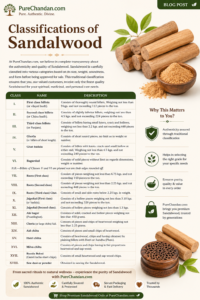
Before sandalwood is sold, it goes through a strict, traditional sorting process. It is divided into exactly 18 official classes based on weight, size, and wood quality.
To make this ancient system easy to understand, we have laid out all 18 classes grouped by their actual type:
1. The Solid Billets (Logs)
These are the large, solid pieces of the main tree trunk. They are highly prized for carving and major processing.
I. First Class Billets (Vilayet Budh): The absolute finest, large, perfectly solid logs weighing at least 9 kg each.
II. Second Class Billets (China Budh): Slightly smaller but still excellent quality logs, weighing at least 4.5 kg.
III. Third Class Billets (Panjam): Good-sized logs that have minor natural flaws like small knots or surface cracks, weighing at least 2.2 kg.
IV. Ghotla: Short, round, solid pieces of wood with no weight limit.
V. Ghat Badala: Full logs that have knots, cracks, or small hollows specifically at their ends.
VI. Bagardad: Solid pieces of wood that don’t fit standard sizes, with no limits on weight or dimensions.
2. The Scented Roots
The roots of the sandalwood tree are highly valuable because they contain a very high concentration of aromatic oil.
VII. Roots (First Class): Large, heavy root pieces weighing at least 6.75 kg.
VIII. Roots (Second Class): Medium-sized root pieces weighing at least 2.25 kg.
IX. Roots (Third Class / Ghat): Small, thin, and side roots that weigh under 2.25 kg.
3. Hollow & Faulty Pieces (Jajpokal & Bagar)
Nature isn’t always perfect. Some parts of the tree grow with hollow centers or heavy cracks, but they are still rich in aroma and excellent for oil extraction.
X. Jajpokal (First Class / Badala): Large hollow pieces weighing at least 3.1 kg.
XI. Jajpokal (Second Class): Smaller hollow pieces weighing at least 1.3 kg.
XII. Ain Bagar (Pseudoghat): Pieces that are solid, cracked, or hollow, weighing at least 450 grams.
4. Chips and Shavings (Chilta & Sali)
When big logs are trimmed, shaped, or cleaned, smaller pieces break off. Every single gram of heartwood is collected.
XIII. Cheria (or Large Chilts / Sali): Large, distinct chips of pure heartwood weighing at least 2.25 grams.
XIV. Aid Chilta: Smaller pieces and fine chips of pure heartwood.
XV. Hatri Chilta: Thin wood shavings obtained specifically when artisans smooth down the big logs using a hand plane (Hatri or Randha).
XVI. Milva Chilta: Mixed pieces that contain a fair proportion of both the dark heartwood (scented) and the lighter sapwood (unscented).
XVII. Basola Bukni (Gamti Tacha): Very small, mixed chips of heartwood and sapwood.
5. Pure Wood Powder
XVIII. Sawdust or Powder: The fine powder obtained directly from the saws when cutting the large sandalwood logs. This is completely pure and ideal for incense paste and face powders.
The PureChandan Promise
In the sandalwood market, true quality is determined by the actual heartwood and oil content, not by fancy regional labels. By understanding these 18 official grades, you know exactly what kind of raw material goes into making authentic sandalwood products.
** Karnataka Forest Manual : Chapter 7(Sales of forest produce) **
https://aranya.gov.in/aranyacms/(S(ullgsnniuwjkrwgpdc3jbeoj))/downloads/Acts/KFD_Manual_1976.pdf